Showing posts with label Eiteljorg Museum. Show all posts

Thursday, October 3, 2013

A Walk in the Park


The White River State Park spans the west side of downtown Indy, 
encompassing the Eiteljorg and Indiana State Museums, 
as well as the Indianapolis Zoo. The Central Canal connects
all with the downtown area where sidewalks allow people 
to use the park for a walk, to ride their bicycles, 
or go for their daily run.


Visitors may rent any number of different vehicles to tour the park:
among them are Segways, bicycles, paddle boats, and kayaks.
There is even a Venetian gondola available for rent.


Broad expanses of lawn allow people to play a game
of Frisbee with other people or with their dogs,
while the sculptures dotted around the grounds often
can become a place for visitors to pause for a rest 
during their bicycle rides.


Monday, December 10, 2012

Winter Blue


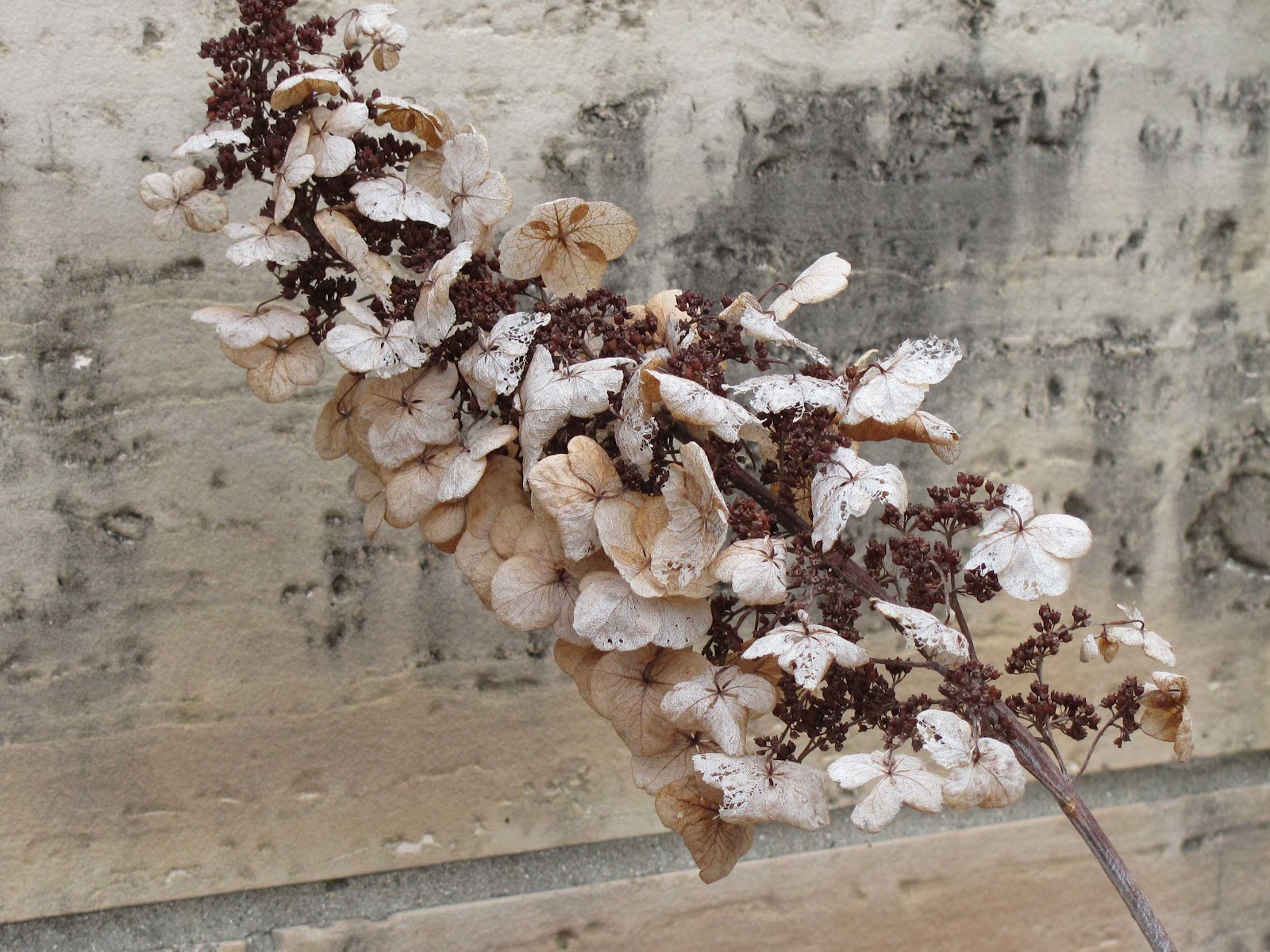
The warmer seasons have faded away, leaving only traces 
of their color and flair. The browns above have
hints of their complementary blues, saving them from
drab boredom. The wilted blooms below
look as though they've been out all night, only to
be caught off guard by the colder temperatures.
Can you say, "Rode hard and put away wet?"


Sunday, October 14, 2012

Yellow and Brown


This patch of ground, just off the Central Canal, lies between the 
Eiteljorg and the Indiana State Museums. Looking west
from the little grove of trees, one can see the main foyer of
the ISM, where a Foucault pendulum sways silently,
back and forth, as the trees change color outside.


Thursday, October 11, 2012

Organized Chaos


I'm not a fan of brown. I have to actively (Huh?) stand to look 
at anything of that hue to find something admirable 
about whatever it is. Consequently, it's pretty safe to say
these hydrangeas looked drab by themselves, but gorgeous when
set against their red leaves. What really attracted me
was the outrageous kaleidoscope of red, purple and green 
with the modest perfection of the brown hydrangeas
quietly holding their own among their flashy friends.


Monday, April 23, 2012

"Steel Ponies"

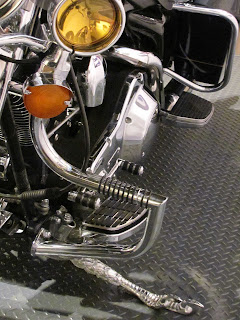
Art Attack, 2005, by Russ Hess of Cowboy Customs. Detail
I opened with a detail of the motorcycle which is the finale of 
"Steel Ponies," an exhibition exploring the art and history that have 
sprung out of the subcultures associated with the motorcycle.
Art Attack was designed and constructed in 2005
by Russ Hess of Cowboy Customs. The motorcycle took 
Hess 800 hours to build and consists of a tooled leather seat, 
saguaro wheel spokes, forty-seven pieces of engraved 
silver overlay, and 115 gold flowers and rubies.
  
Art Attack, 2005, by Russ Hess
The show opens with a shining red and black 1948 
Indian Chief Roadmasterwith its trademark large-skirted fenders. 
The Roadmaster debuted in 1922 and was Harley-Davidson's 
main competitor in the V-twin heavyweight class.

1948 Indian Chief  Roadmaster

Visitors are then shown various examples of early motorcycles, 
beginning with a 1902 Indian Camelback
which is virtually a bicycle with a motor attached. 


1902 Indian Camelback, on loan from
the Smithsonian Institution, Museum of American History,
Kenneth E. Behring Center

The 1998 Harley-Davidson Road King shown below is owned by
United States Senator Ben Nighthorse Campbell, who in 1992
became the first Native American to serve Congress
in more than 60 years.

1998 Harley-Davidson Road King
on loan from Senator Ben Nighthorse Campbell.

Detail of the Road King showing
the eagle's talon kick stand.
To people "of a certain age," there are three movies which
described the feelings of alienation from society felt by many
young people, the motorcyclists depicted in The Wild Ones
the 1953 movie starring Marlon Brando; The Wild Angels,
which came out in 1966 with Peter Fonda; and the
iconic 1966 film Easy Rider, starring Peter Fonda 
and Dennis Hopper as Captain America and Wyatt.
  
Detail of Captain America Bike from Easy Rider
While I don't remember the first two movies, I do recall
seeing Easy Rider and remember the dread and
revulsion I felt over the movie's conclusion. I haven't
been able to watch it since. Four used cop bikes,
Harley-Davidson Hydraglides were converted by
builders Cliff Vaughns and Ben Hardy to create the 
motorcycles for the main characters, played by
Peter Fonda and Dennis Hopper. Of the four,
three were stolen towards the end of production 
on the movie. The fourth, the Captain America destroyed
at the end of the movie, was rebuilt from the remaining 
parts by Dan Haggerty.

Foreground, Captain America bike from Easy Rider,
1969; background left, 1953 
Chino Bobber from The Wild One
and right, Dragon Bike
from 1966 movie 
The Wild Angels.


Sunday, April 22, 2012

More ...

Left-Handed Katsinas, 1999 (Detail). Aaron Fredericks (Hopi)
Carved and painted cottonwood root.

When I was photographing these Katsina figures, 
I felt as though two pair of dark eyes were watching me 
from behind their masks. It wasn't so much that I found the figures
to be "realistic," but more that the spirits portrayed seemed to have 
merely paused in their work while I walked through the room.
In fact, when I looked around and saw so many 
of the carved figures, I knew I would have to return 
another day, just to explore and to take their pictures. 
And to let the Katsina continue their work.

Left-Handed Katsinas

All of the work shown here is contemporary, done by craftsmen
who have carefully studied the artistic traditions of their ancestors 
in effort to carry on the heritage left to them. They are also seeking to
add to those traditions by exploring new forms and designs. 
This will keep the craft new and avoid their work becoming 
merely stale repetition of past successes. 

Haida Thunderbird Headdress, 1998
Robert Davidson (Haida, born 1946)
Red cedar, shell, and raffia
The two examples below are example of pottery traditions
that have survived because of study and respect for 
traditions and forms of the past, and of the courage to explore 
and develop new forms. Both potters are decendants
of Nampeyo, a Hopi artist who studied ancient potshards 
she found on the Hopi reservation where she lived,
developing her own style based on the traditional designs.
Within her lifetime, she was recognized as one of the
finest Hopi potters.

Seed Pot by Les Namingha
(Hopi-Tewa/Zumi, born 1968

Les Namingha is the grandson of Rachel Namingha Nampeyo,
who was the granddaughter of Nampeyo. The artist learned
his pottery making skills from his aunt, Dextra Quotskuyva,
herself a granddaughter of Nampeyo. Les is known as an innovator, 
always experimenting with new forms and designs.

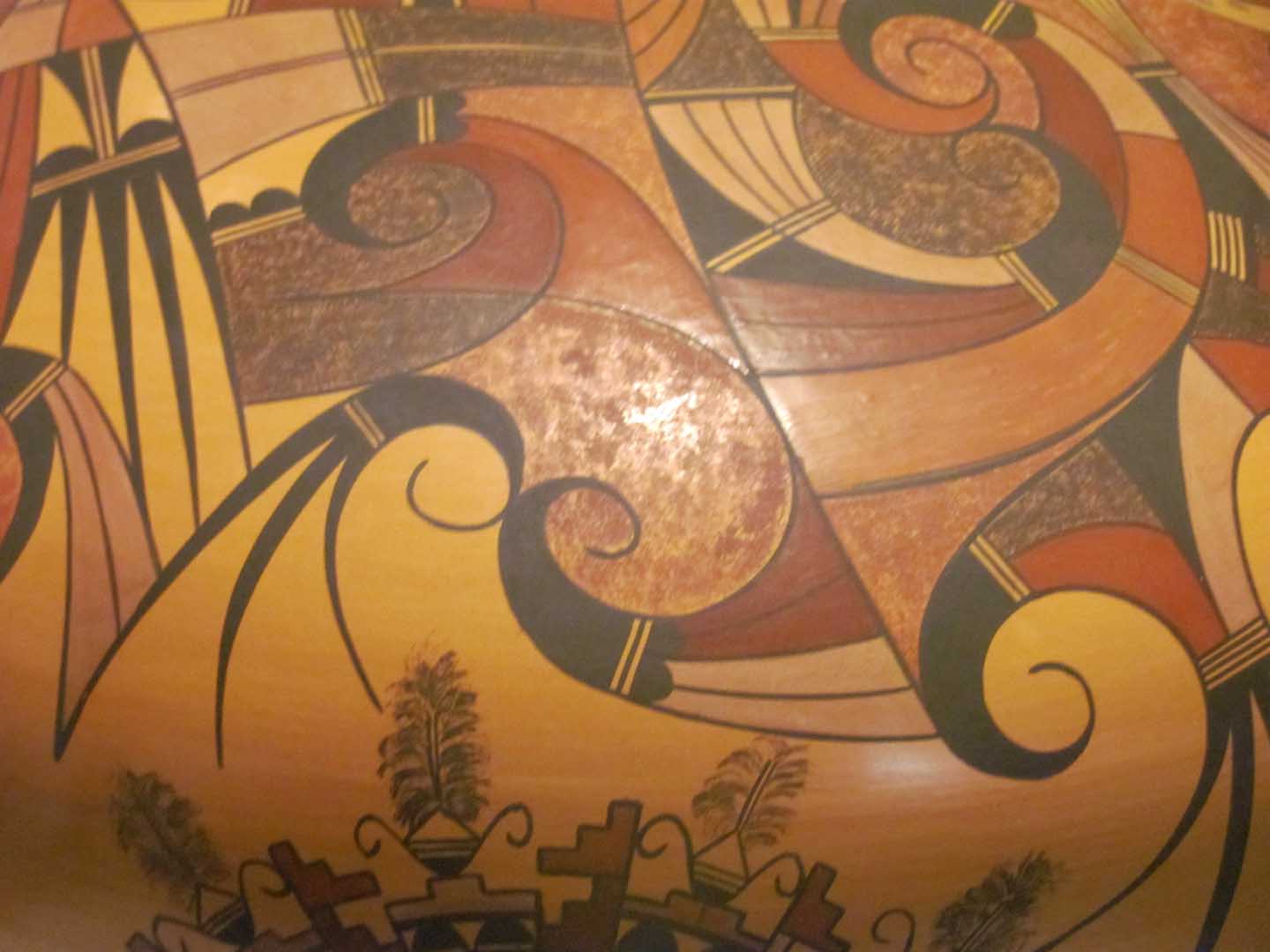
Seed Pot, detail


Pot, 1990s, by Jacob Koopee (Hopi-Tewa, born 1970)
Jacob Koopee is the son of potters, Jacob Koopee, Sr. (Tiwa)
 and Georgia Dewakuku Koopee (Hopi). Among his teachers 
was his aunt, Dextra Quotskyva and his grandmother, Marie Koopee.
Jacob's great-great-grandmother, Nampeyo, derived much
of her design style from imagery found in the ancient Hopi village
of Sityaki. Much of Koopee's work is based on this design style.

Pot, Detail

Sunday, March 4, 2012

Winter Blooms


After a week or so of warmish temperatures, we're back to winter's
gray hues with the floral ghosts of a summer past.
These pictures were taken on the grounds of the Eiteljorg Museum
in downtown Indianapolis. The museum, which houses a collection of
Native American art and artifacts, is a beautiful building.
It stands on the Central Canal along with the Indiana State Museum
and the Indianapolis Zoo. The canal itself forms the basis of 
the White River State Park and is a pleasant place to walk
or enjoy one's lunch hour during the work week.


Although the main entrances to both museums are on Washington Street, 
there's no doubt the more beautiful entries are located on the Canal.
The picture below was taken looking from  canal entrance of the 
Indiana State Museum towards downtown. The Eiteljorg
entrance is the darker tan stone on the right of the picture. 

Thursday, August 18, 2011

Venice by the Cornfield

Looking southwest, the Indiana State Office Building is shown in the background,
while a glimpse of the J.W. Mariott Hotel can be seen behind the tree.

Not really, but eh, what the hell, it might catch some attention. 


Until the development of the steamboat in 1807, people had never traveled by any means other than on foot, horse power, or by boats and ships pushed by the wind. Roads were hopelessly tedious and uncomfortable, making the country's rivers the preferred mode of travel. 


When the Erie Canal was completed in 1825, connecting the east coast at Albany, New York with Erie, Pennsylvania its success launched decades of "canal fever" by states eager to provide their landlocked citizens with a way to get themselves and their produce to markets on the east coast and New Orleans. 


Indiana was not alone in this craze, but only one of its planned canals was completed, the Wabash and Erie Canal. Connecting Lake Erie at Toledo with the Ohio River, the canal route roughly paralleled the Maumee, Wabash and White Rivers over 468 miles, making it the longest canal in the country. Only two sections of Indiana's other planned canals were completed: the Whitewater Canal in southeastern Indiana, and the Central Canal in Marion County.


Construction of the Indiana Central Canal began in 1836 and was meant to connect Peru with Evansville over 296 miles, generally following the path of the White River. Portions of the canal still supply water to the city, while other sections serve as recreational areas. Stretching through the west side of downtown Indy, it connects the Indianapolis Zoo, the NCAA Headquarters and Hall of Champions, the Indiana State Museum, and the Eiteljorg Museum of American Indians and Western Art. 
"Big Blue," the new J. W. Mariott Hotel,
opened at Indianapolis in February, 2011.
Restored in the 1980s and extended in 1995, this portion of the canal is part of the White River State Park, extending from Eleventh Street on the north at Boggs Temple, to the White River just above West Washington Street. Other sections of the canal can be seen on the grounds of the Indianapolis Museum of Art, Butler University, and running through the Broad Ripple neighborhood