Showing posts with label Indiana Historical Society. Show all posts

Tuesday, December 9, 2014

Questions from the Author Fair


Saturday afternoon, seventy Hoosier authors 
met visitors to the Indiana Historical Society's 
12th Annual Holiday Author Fair. 
From noon until four o'clock people streamed 
into Eli Lilly Hall, browsing the varied offerings, 
talking with the authors, and buying books.
Among the more popular authors present was
Bobby "Slick" Leonard, Hoosier basketball legend,
who happily met his many admirers and signed
their copies of his book.
In this case, it's a pleasure to say that the
sports books outsold the offerings from a couple
of the more strident representatives of
a radically conservative leaning, by about two to one.
You go, Slick!


I spent the afternoon seated between a man 
who had written a book about Hoosier prisoners 
at Andersonville, one of the largest of the 
Confederate military prisons of the Civil War, 
and Ed Wenck, whose book
sold out long before the event concluded.
What I found most interesting was the number of 
people who spoke to him who told of murders
in their families, one recounting the slaughter
of an entire household of relatives.
We read every day of random shootings,
of brutalities visited in almost routine fashion
upon people we regard as "others," "not us."
These people, all white, all middle class,
were also carrying around this terrible burden.
Isn't it about time we acknowledged this horror is
just below the surface of our existences,
that we share unspeakable sorrows?
Maybe then we could come together for a way
to lessen the number of these tragedies. 


Most of the visitors were adults, which led me 
to also wonder if we were seeing the last of a generation 
that uses shredded trees as a reading device. 
Myself, I love the smell of ink, the feel of paper 
in my hand, and the look and rhythm 
of a well-designed page. How will it be 
for the ones coming along with e-devices?

Sunday, December 7, 2014

Fra-GEE-lay


As I left the Holiday Author Fair on Saturday 
at the Indianapolis Historical Society,
I paused at the living room setting in the lobby. 
Meant to represent the home from "A Christmas Story,"
the set includes presents under the tree - 
Dad's blue bowling ball, a Flexible Flyer sled, 
and the infamous Red Ryder BB gun.
Visitors can dress up in the awful, humiliating
pink bunny PJs and have their picture taken with
the wondrously ugly leg lamp.


In the top picture, a visitor takes a picture of her daughter 
for Instagram while my sister-in-law, Fran,
watches in the background. 
The father in the easy chair beside leg lamp 
waits patiently for his family to don pink pajamas.
The leg lamp is fondly gazed upon by just about
everyone who's seen the movie, recalling Darren McGavin 
as the Dad and his pride in the "important prize,"
totally oblivious to his wife's dismay.


And lastly, here is SDP, resplendent in Ralphie's 
bunny ears and glasses, posing with the carton 
for a Red Ryder BB gun, the gift 
most coveted by Ralphie.
Rest assured, I will abide by my own
quirky Christmas tradition: I will
watch A Christmas Story at least once during
its Christmas day marathon on cable TV.


Monday, October 6, 2014

Cafe on the Canal


I went down to the patio at the Indiana Historical Society,
a place where I could sit out of the sun 
to write or sketch. Next to the Canal, 
the site seemed private, despite the constant parade 
of joggers, cyclists, and people in paddle boats.
Flocks of geese and ducks came in to alight on the Canal, 
sending up sprays of water as their feet braked
on the surface. I sat for a half hour, feeling as though
I had the place to my own. When I left, I realized
another woman had the same idea;
as she sat under a cafe umbrella, she read
her e-book, probably with the same
feeling of peace that I'd enjoyed. 


Thursday, October 2, 2014

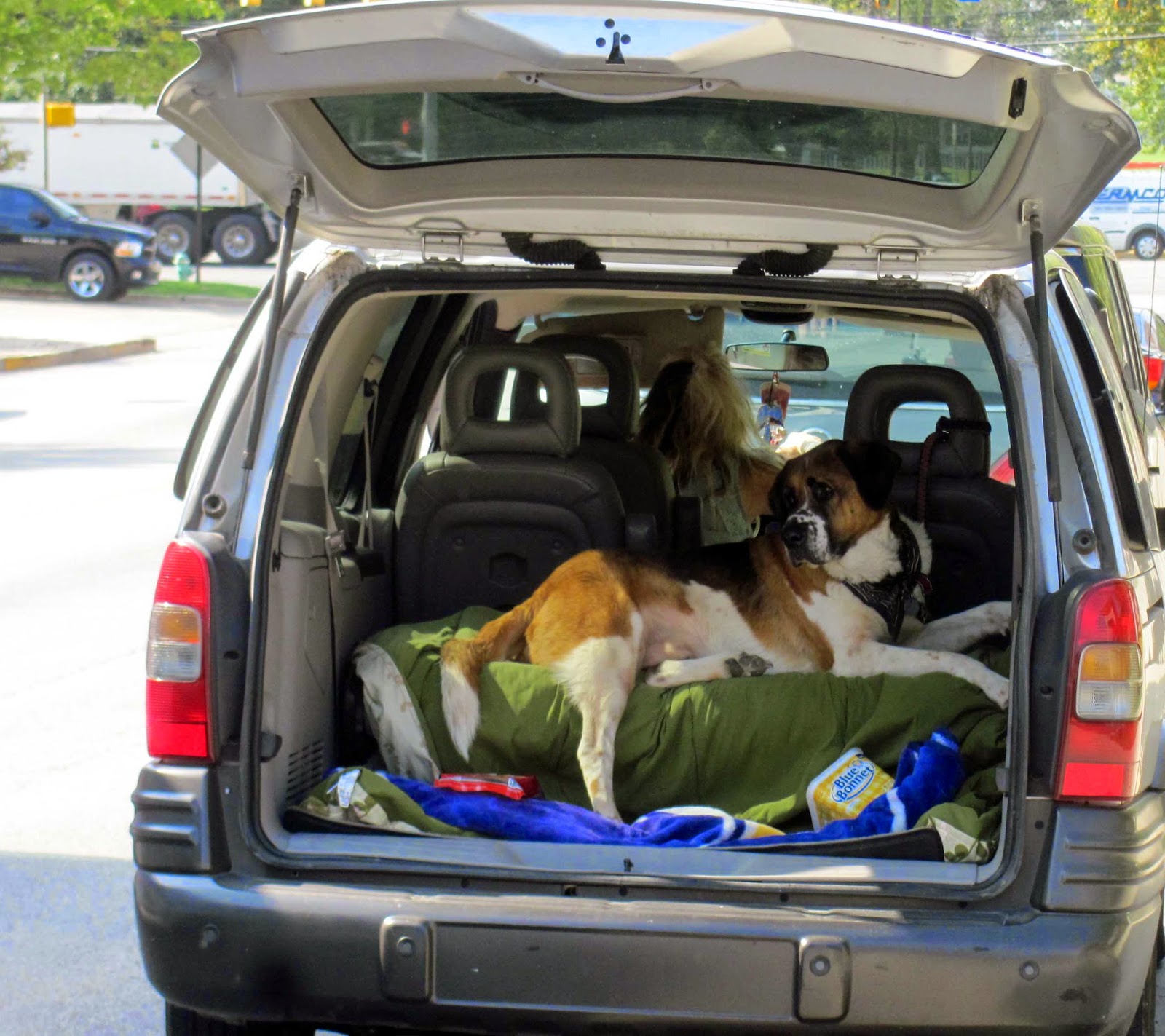
Waiting for Daddeh


When I got off the bus outside the Indiana Historical Society 
this afternoon, I noticed a car waiting curbside 
to pick up a passenger. Since the rear door of the SUV
was open, it may have been that the big doggeh's
human was making a delivery. At any rate, the entire
back seat was designated for the comfort
of the dog, and as he lazed in the sun, any breeze
that may have lifted his fur a bit
was undoubtedly appreciated. 


Friday, January 24, 2014

Just About ...


A month ago, the winter season began and, 
with very little respite, it has been a misery of cold 
that quickly seeps into the bones along with 
the unaccustomed wind chill. 
Waiting for the bus near the Indiana
Historical Society, I looked into the Central Canal
where I was surprised to see gold fish
swimming just under the surface. 


The water was warm enough that steam rose 
from its surface. Ducks swam upstream,
themselves huddled against the frigid winds
 like their human counterparts 
on the streets above.


Monday, July 29, 2013

Summer Breeze on the Canal


The downtown Canal is always a popular spot for walkers, 
joggers, people rowing skulls or paddling kayaks.
Couples can often be seen pedaling little sternwheel
boats the length of the canal, often guiding their craft around
the occasional Venetian gondola.

This summer, the temperatures are averaging as
much as thirty degrees cooler than last year,
making for breezy, pleasant evenings listening
to jazz at the Indiana Historical Society.


Here spectators can be seen settling in to listen 
to the band, just then in the process of setting up 
for the evening's entertainment.


Tuesday, April 2, 2013

Back Through Time


As I walked through the mist to enter the year 1955,
 I was confronted by a stack of cardboard boxes, representing 
a small portion of the millions of vials of Salk vaccine 
produced world wide by the Eli Lilly Company 
and four other drug companies to help eradicate 
the polio virus. Once it was tested and proven safe,
Indiana doctors quickly acted to immunize 240,000 people.


Polio outbreaks in the 1940s and 1950s constituted a public health crisis.
The room represents an area where assembly-line workers
packaged and shipped the vaccine to communities nationwide
to help end the nation's panic.

During the last outbreak, in 1952, highest admission rate 
per 100,000 people was for children ages three, four, five, and six.
This was brought home by the pediatric "iron lung" shown 
below and a small leather and steel leg brace 
included among the displays. The child would lie inside the box
on a thin striped pad, with only its head sticking out. 
Pumps controlled airflow inside the sealed chamber, 
simulating the act of breathing for those who had lost 
the muscle control and strength needed to breathe independently.


As I left the exhibit, I took another look at the quote 
on the poster that had greeted me when I entered:
"Once you've spent two years trying to wiggle one toe,
everything is in proportion." 
-- President Franklin D. Roosevelt, 1945

I thanked good fortune that I was among the many millions
of children nationwide, who were able to line up at their schools
to receive inoculations of the Salk vaccine in 1955.
I walked back through the short dark tunnel, through the
mists where I was among people, most of whom had
no knowledge or recollection of the real fear
that gripped the people during these years.   


You Are There 1955: Ending Polio
will be a component of the Indiana Experience
at the Indiana History Center through September 14, 2013.

Friday, August 10, 2012

A Quiet Morning


The morning was gray and humid when I took these 
pictures of the west end of the Central Canal.
Looking west, the White River can be seen
beyond the street light. People were using the quiet time
to take a walk or go for their morning run.
The taped off ladder at the corner of the canal is the
site where swimmers would emerge the next morning,
completing the first leg of a triathlon.


Yep, they would use the Canal for the swimming 
portion of the competition, then transfer to their bicycles
to begin a route that would take them over the bridge to
the White River Promenade and beyond.
The bridge above, which is near the State Office
buildings and Indiana Historical Society,
must have been about the half-way mark of the
swimming competition.


Thursday, August 18, 2011

Venice by the Cornfield

Looking southwest, the Indiana State Office Building is shown in the background,
while a glimpse of the J.W. Mariott Hotel can be seen behind the tree.

Not really, but eh, what the hell, it might catch some attention. 


Until the development of the steamboat in 1807, people had never traveled by any means other than on foot, horse power, or by boats and ships pushed by the wind. Roads were hopelessly tedious and uncomfortable, making the country's rivers the preferred mode of travel. 


When the Erie Canal was completed in 1825, connecting the east coast at Albany, New York with Erie, Pennsylvania its success launched decades of "canal fever" by states eager to provide their landlocked citizens with a way to get themselves and their produce to markets on the east coast and New Orleans. 


Indiana was not alone in this craze, but only one of its planned canals was completed, the Wabash and Erie Canal. Connecting Lake Erie at Toledo with the Ohio River, the canal route roughly paralleled the Maumee, Wabash and White Rivers over 468 miles, making it the longest canal in the country. Only two sections of Indiana's other planned canals were completed: the Whitewater Canal in southeastern Indiana, and the Central Canal in Marion County.


Construction of the Indiana Central Canal began in 1836 and was meant to connect Peru with Evansville over 296 miles, generally following the path of the White River. Portions of the canal still supply water to the city, while other sections serve as recreational areas. Stretching through the west side of downtown Indy, it connects the Indianapolis Zoo, the NCAA Headquarters and Hall of Champions, the Indiana State Museum, and the Eiteljorg Museum of American Indians and Western Art. 
"Big Blue," the new J. W. Mariott Hotel,
opened at Indianapolis in February, 2011.
Restored in the 1980s and extended in 1995, this portion of the canal is part of the White River State Park, extending from Eleventh Street on the north at Boggs Temple, to the White River just above West Washington Street. Other sections of the canal can be seen on the grounds of the Indianapolis Museum of Art, Butler University, and running through the Broad Ripple neighborhood