Showing posts with label Indiana State Museum. Show all posts

Monday, January 26, 2015

Always There, Unnoticed


I've passed by these items for years without noticing 
their special rough/smooth relationships,
but Saturday the bark of the tree and its subtle
coloration displayed beautifully against
the smooth metallic surface of the vent.
Below, a hand rail flashed its brushed metal
surface as it curved around the retaining
wall at the Central Canal, near the fire station.


Sunday, December 29, 2013

Blue Curve/Yellow Wedge ... and One Hell of a Dancing Horse


After swimming at the Natatorium early Saturday morning, 
I walked along the Canal to return to the downtown 
area where I went for breakfast.
The morning was bright and beautiful, offering the best
of winter colors in the form of crisply hued blue sky,
caught between the dark blue curve of the Marriott hotel and 
the sunlit wedge of the Indiana State Museum atrium.

And just because I really enjoy it, here's a freestyle 
dressage performance from a few years ago 
at the 2006 World Equestrian Games in Germany.


It must have been an encore of sorts. Here's
the same pair doing a longer freestyle routine 
for scores. The mare could bust some moves!


Thursday, October 3, 2013

A Walk in the Park


The White River State Park spans the west side of downtown Indy, 
encompassing the Eiteljorg and Indiana State Museums, 
as well as the Indianapolis Zoo. The Central Canal connects
all with the downtown area where sidewalks allow people 
to use the park for a walk, to ride their bicycles, 
or go for their daily run.


Visitors may rent any number of different vehicles to tour the park:
among them are Segways, bicycles, paddle boats, and kayaks.
There is even a Venetian gondola available for rent.


Broad expanses of lawn allow people to play a game
of Frisbee with other people or with their dogs,
while the sculptures dotted around the grounds often
can become a place for visitors to pause for a rest 
during their bicycle rides.


Sunday, December 23, 2012

Presents for the Kids, Part 2


I finished shopping for the kids today, so I now have a present 
each for eight children aged 5 and under. It's easy when they're so young,
but I still try to find them to suit the child. What is difficult is
finding age-appropriate stuff that hasn't been commercialized into
plastic banality, creating only plastic, banal adults.
Two of them are now old enough for beautifully illustrated
picture books. Hopefully, they will be captured by the color and line
of the drawings, entering into the world of the written word,
guided by art and design.


These pictures are of the animated window displays from the old 
L.S. Ayres & Company Department store, which was located
at the corner of Washington and Meridian Streets from 1905 until
it was closed in 1990. Along with this display, furniture and decor 
from the Ayres' Tea Room was kept and re-created 
in the Indiana State Museum. During the Christmas season,
one can enjoy the store's displays, Christmas train and
the Tea Room's famous Chicken Velvet Soup.


Wednesday, December 12, 2012

Entry


Visitors to the Indiana State Museum are greeted by this tall sculpture, 
INDIANAits letters standing on one anothers' shoulders.
I imagine it wrapped in a big trench coat, running about the country 
pretending its a bigger more powerful state.


 The drive outside the main entry has this low-key installation 
at its center. The buildings in the background are hotels 
and parking garages. The winter brown brush is a wildflower garden.

Sunday, December 9, 2012

Acne Laughs ...


Ha-ha-ha! Ho-ho-ho!
Downtown Indy was busy this morning.
I first went to the Indiana State Museum which was bustling
with families milling about with kids of various ages.
There was a choir singing Christmas songs, with dutiful
moms and dads in attendance to see their beloved spawn 
sing all the standards at about three-quarters the intended speed.
I finished my shopping there, then went to Circle Centre Mall,
which was also packed with people in various stages
of holiday shopping duress - two weeks out, so still too early
for outright desperation. The dominant group
this weekend was the overwhelming number of teen-age
girls running about, their long, coltish legs sticking
out below little cheer-leading outfits, and their
hair as be-ribboned as any Russian gymnast's.


Apparently, there was a competition being held at the adjacent 
Indiana Convention Center and the girls were biding their time between 
events by wandering the stores with their parents.
Oh, yeah, "acne laughs at soap and water."

Monday, October 15, 2012

Counties on the Walls


Clad in native limestone, the Indiana State Museum has, 
interspersed among the stones, relief sculptures representing 
characteristics for which each county is known. 
Here are three additional sculptures,
in addition to those I showed last week.

The twining vines above represent the truck gardening
of Tipton County. Prehistoric mounds, believed to have 
been constructed by Native Americans of the Adena-Hopewell 
cultures, are shown for Madison County. The manufacture 
of automobile parts is represented by the 
use of taillights for the feathers.


Tippecanoe County was the home of Shawnee Chief Tecumseh, 
and his brother, Tenskwatawa, also known as The Prophet.
Together they formed a united Native American force they hoped
would drive the white settlers south, across the Ohio River.
Tecumseh was a sophisticated tactician and visionary, whose
intellect and leadership was respected and admired by
the military leaders he fought against in the early 19th century.


The sculptures were designed by 2nd Globe Studios of Indianapolis,
which has studios in Indianapolis and Vancouver, BC.

Sunday, October 14, 2012

Yellow and Brown


This patch of ground, just off the Central Canal, lies between the 
Eiteljorg and the Indiana State Museums. Looking west
from the little grove of trees, one can see the main foyer of
the ISM, where a Foucault pendulum sways silently,
back and forth, as the trees change color outside.


Wednesday, October 10, 2012

Indiana in Relief


Every time I walk along the Central Canal, I end up taking pictures 
of the relief sculptures dotted around the limestone exterior 
of the Indiana State Museum. There is one for each country, showing 
some aspect of the county's history or resources.
I've taken a number pictures of them, but I didn't know how
to begin showing them, I guess because I want to do all ninety at once.

The relief above is for Carroll County, which is known for
its soybean production and the Freeman Reservoir,
a 2,800-acre lake.


The open car door shown here is for Madison County, 
known for its early participation in the automotive industry,
businesses which grew to include the manufacture of headlights, 
taillights, horns, batteries and other accessories.


The county seat of Delaware county, Muncie, was named after 
the Delaware chief Munsee, and is the center of manufacturing for home
canning equipment and glass food containers, particularly Ball jars.
The cartoon strip Garfield was developed by Jim Davis
in Muncie and work on the strip is done there.


 Ohio County, the smallest of the state's counties, 
is located in southeastern Indiana, just outside of Cincinnati.
Before the Civil War up to 100 steamboats and flatboats
would depart each week from the wharves at Rising Sun.

Wednesday, August 8, 2012

Steam Clock


This steam powered clock is posted at the Canal entrance 
of the Indiana State Museum. It was percolatin'
along when I walked by, but the whistles did not play while I was there.
Damn! I wanted pictures of it spewing as it sang its greeting.


This from the plaque on its base:
"The Indiana Steam Clock was designed for the
Indiana State Museum by horologist Raymond L. Saunders.
... [The] clock is made of stainless steel, with brass trim,
is 17 feet high, and weighs 1.5.tons. High pressure steam,
that heats the museum, is reduced to 20 PSI for the 8 brass whistles.
The steam whistles play 'Back Home Again in Indiana' on the 
quarter hourThe four clock dials are operated by the weight driven
mechanism which has a 'pinwheel' escapement and is wound
by an electric motor and loop chain system.
A model of the Earth, rotating at 3RPM, is illuminated
by a miniature 'sun' lamp."


Below is a short video of the clock playing its tune.
There were others, all of which sounded worse.
I think the clock needs some attention paid to it as
I've heard it sound better.


Sunday, March 4, 2012

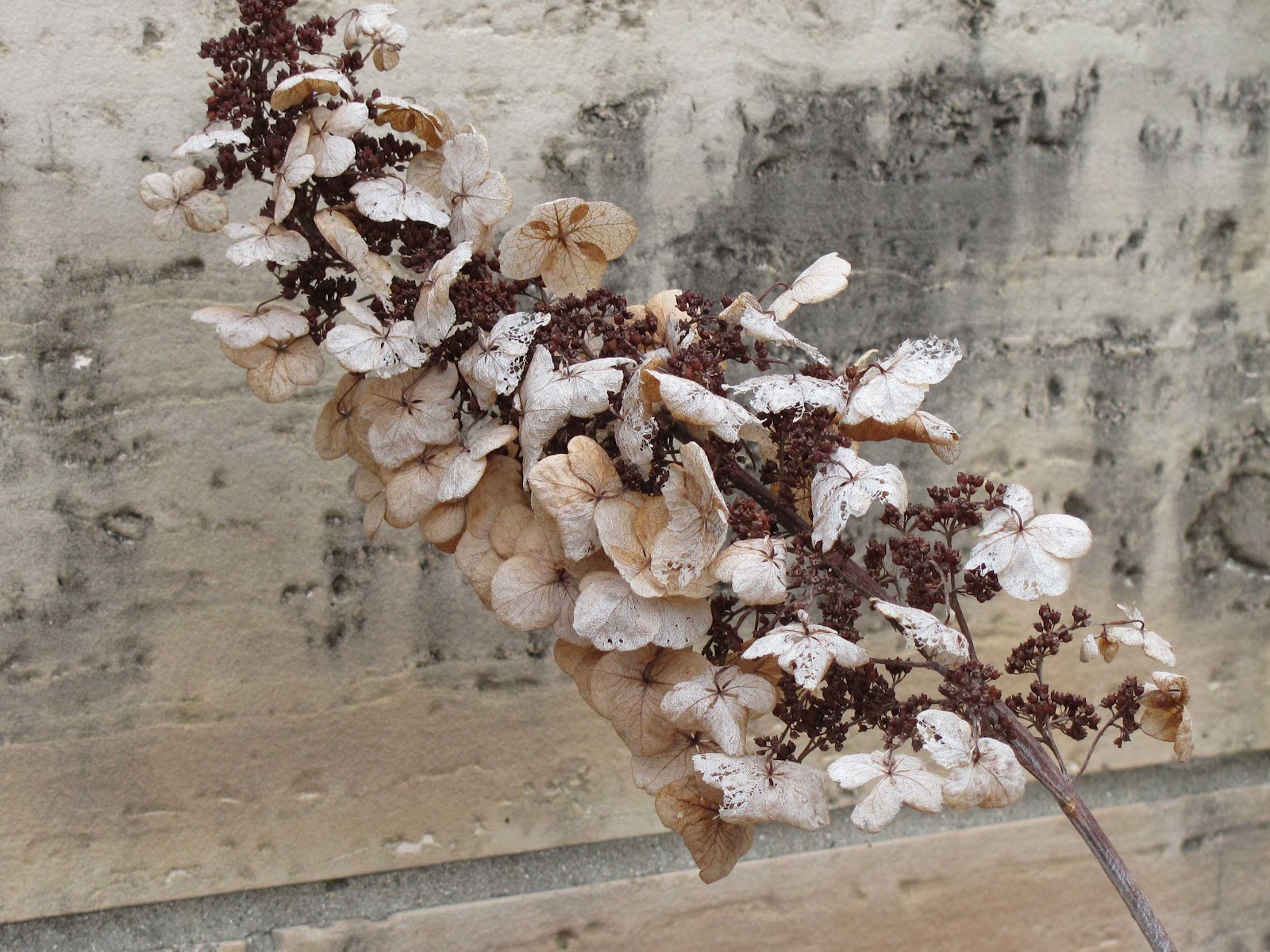
Winter Blooms


After a week or so of warmish temperatures, we're back to winter's
gray hues with the floral ghosts of a summer past.
These pictures were taken on the grounds of the Eiteljorg Museum
in downtown Indianapolis. The museum, which houses a collection of
Native American art and artifacts, is a beautiful building.
It stands on the Central Canal along with the Indiana State Museum
and the Indianapolis Zoo. The canal itself forms the basis of 
the White River State Park and is a pleasant place to walk
or enjoy one's lunch hour during the work week.


Although the main entrances to both museums are on Washington Street, 
there's no doubt the more beautiful entries are located on the Canal.
The picture below was taken looking from  canal entrance of the 
Indiana State Museum towards downtown. The Eiteljorg
entrance is the darker tan stone on the right of the picture. 

Wednesday, November 9, 2011

Rambles


While walking toward the center of town, I happened to see a purple golf cart parked on the sidewalk. Purple? I looked around and saw a couple window washers just above, hanging from bosuns' chairs, moving themselves along the sides of the Old National Bank building using handles with suction cups on the bottom - visions of jewel thieves on a caper danced through my head, along with the tune "Slip Slidin' Away," as they rappelled down the side. 


After I left the Herron Gallery, I headed for the Canal, where I walked to the Zoo and returned, taking pictures along the way. I don't know who plans the landscaping for the Canal but the flowers and plants are beautiful. The above picture was taken looking west towards the Indiana State Museum with the Canal in the foreground.


It's so beautiful! But what is it?


Tuesday, September 13, 2011

Another Textured Tuesday: On Limestone & Vine

I started early enough there was still dew on the plants and flowers.
Even the humble kale looked to be dressed in sequins. Unfortunately,
it just didn't show in the pictures.

This morning, I took my little camera for another long walk, this time along the western section of the Canal Walk from the State Office Building to the  NCAA Headquarters building and into White River State Park along the Riverwalk behind the Indianapolis Zoo.

Yep, here I am at the corner of Limestone & Vine, where the canal turns south
to run along between the Indiana State Museum and the  NCAA Headquarters.

 I made another right turn where the Canal turned towards an expanse of lawn, then fed back into the White River. Beginning with the old Washington Street Bridge, which is now a sculpture park, Riverwalk follows the river behind the Indianapolis Zoo. Walled in with massive blocks of rough-hewn limestone, it reveals numerous small beauties and surprises and is a popular place for joggers and casual walkers.

A self-portrait in shadows and granite.

Looking south beneath the Old Washington Street Bridge at other bridges
which also span the White River on the west side of downtown Indianapolis.

And now we enter the shade and beauty of the River Walk which stretches behind the Indianapolis Zoo. Office workers, athletes and firefighters assigned to a near-by station are among the many people who enjoy the trail.

Yes, there are many "pretty weemin," but
I prefer the sight and scent of the species above. Oooh.
A limestone "rose" hidden among its massive brethren.
The crooked little tree and giant limestone blocks
play off and accent each other, adding to the beauty of each.
The path doesn't end at the Zoo's boundary at White River Drive, but continues along that drive and, depending on the direction you choose, will take you north -- to the Indianapolis Museum of Art and northward beyond the county lines -- or back downtown. Here, I turned around to walk the other side of the Canal, where there are additional treats to be seen, which I will show another time as they deserve their own little show.


Jogger passing under the Promenade
outside the ISM Administrative Offices


And I will end with a picture of a couple of the many turtles I saw in the driftwood caught under the piers of the bridge. They were happily swimming, drifting and basking on logs in the river. Just as the turtles extended their necks to look around them, my little camera strove mightily to help me with these pictures, exhausting itself soon after. 


Thursday, August 18, 2011

Venice by the Cornfield

Looking southwest, the Indiana State Office Building is shown in the background,
while a glimpse of the J.W. Mariott Hotel can be seen behind the tree.

Not really, but eh, what the hell, it might catch some attention. 


Until the development of the steamboat in 1807, people had never traveled by any means other than on foot, horse power, or by boats and ships pushed by the wind. Roads were hopelessly tedious and uncomfortable, making the country's rivers the preferred mode of travel. 


When the Erie Canal was completed in 1825, connecting the east coast at Albany, New York with Erie, Pennsylvania its success launched decades of "canal fever" by states eager to provide their landlocked citizens with a way to get themselves and their produce to markets on the east coast and New Orleans. 


Indiana was not alone in this craze, but only one of its planned canals was completed, the Wabash and Erie Canal. Connecting Lake Erie at Toledo with the Ohio River, the canal route roughly paralleled the Maumee, Wabash and White Rivers over 468 miles, making it the longest canal in the country. Only two sections of Indiana's other planned canals were completed: the Whitewater Canal in southeastern Indiana, and the Central Canal in Marion County.


Construction of the Indiana Central Canal began in 1836 and was meant to connect Peru with Evansville over 296 miles, generally following the path of the White River. Portions of the canal still supply water to the city, while other sections serve as recreational areas. Stretching through the west side of downtown Indy, it connects the Indianapolis Zoo, the NCAA Headquarters and Hall of Champions, the Indiana State Museum, and the Eiteljorg Museum of American Indians and Western Art. 
"Big Blue," the new J. W. Mariott Hotel,
opened at Indianapolis in February, 2011.
Restored in the 1980s and extended in 1995, this portion of the canal is part of the White River State Park, extending from Eleventh Street on the north at Boggs Temple, to the White River just above West Washington Street. Other sections of the canal can be seen on the grounds of the Indianapolis Museum of Art, Butler University, and running through the Broad Ripple neighborhood